

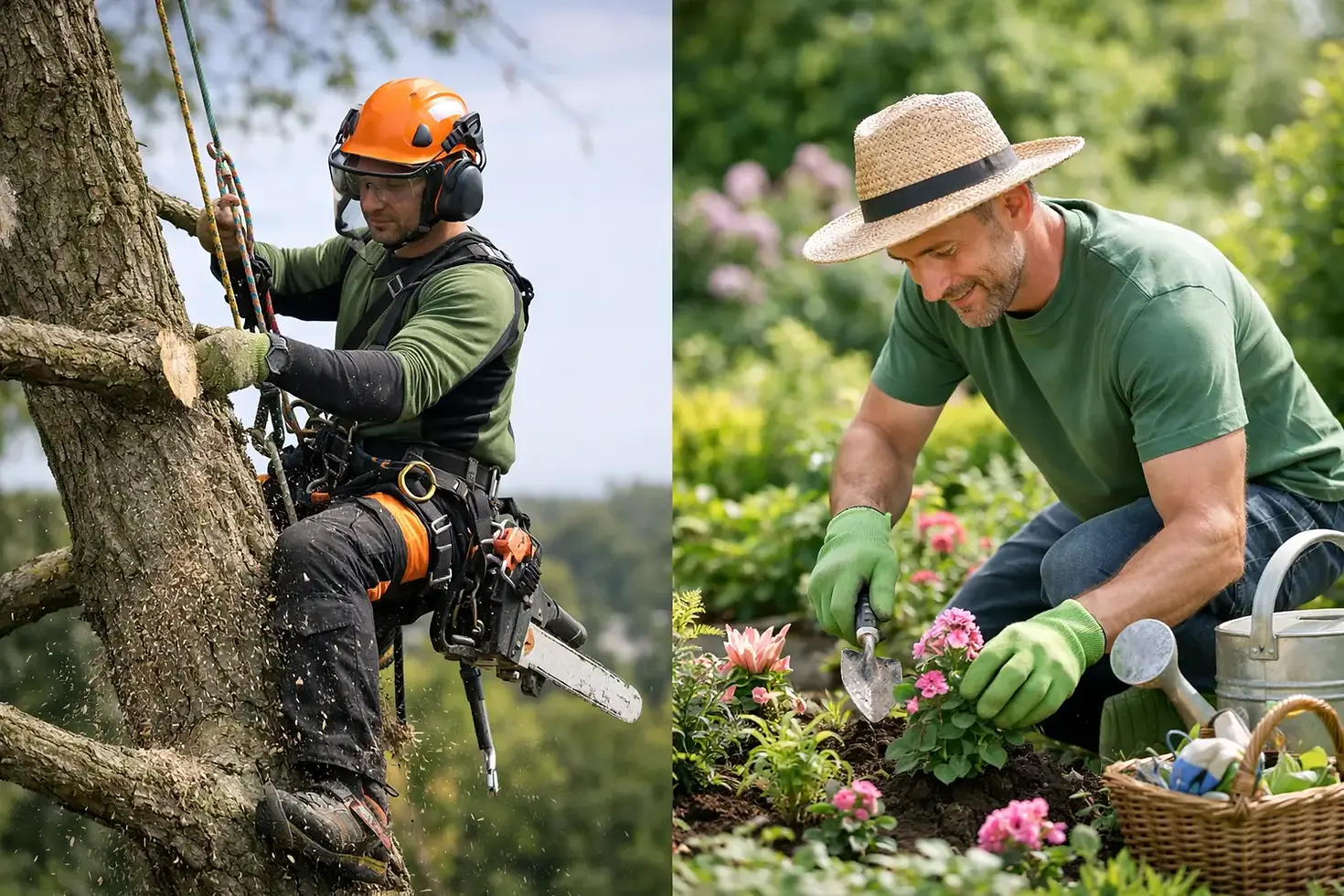
Tree Surgeon vs Gardener Qualifications
- May 1
- 6 min read
If you are comparing tree surgeon vs gardener qualifications, you are usually not planning a minor job. You are trying to work out who can safely handle work at height, who is qualified to manage living trees properly, and who is best suited to the wider upkeep of your outdoor space. That distinction matters because trees and gardens overlap, but the training behind each role is not the same.
A well-kept garden may involve mowing, hedge trimming, border care and seasonal tidy-ups. Tree work can involve chainsaws, climbing equipment, rigging, decay assessment, legal responsibilities and British Standards. On the surface, both jobs happen outdoors and both may offer pruning services, but the level of risk and technical responsibility can be very different.
Tree surgeon vs gardener qualifications: what is the real difference?
The clearest way to separate the two is this - a gardener is generally trained to maintain and improve gardens, while a tree surgeon is trained to assess, prune and remove trees safely and correctly. A gardener may be very experienced in planting schemes, lawn care, hedge maintenance and general grounds upkeep. A tree surgeon works in a more specialised field where safety, access, equipment handling and tree biology all play a larger role.
That difference shows up in qualifications. Gardeners are not always expected to hold formal certificates for routine maintenance work. Many build their reputation through practical experience, horticultural knowledge and the quality of their results. Tree surgeons, by contrast, should be able to show evidence of formal training where the work involves chainsaws, climbing, aerial rescue or dismantling trees.
For a homeowner or property manager, this is not about looking down on one trade in favour of another. It is about choosing the right person for the right task.
What qualifications should a tree surgeon have?
In the UK, tree surgery is a safety-critical trade. If someone is pruning a mature tree over a driveway, reducing a crown near a building or dismantling a damaged tree in sections, formal competency is essential.
A professional tree surgeon will often hold NPTC City & Guilds qualifications for chainsaw use and other relevant operations. These certificates are widely recognised across the industry and help show that the operator has been assessed rather than simply self-taught. If climbing is involved, qualifications for aerial cutting and aerial rescue are especially important.
Beyond the core tickets, you may also see CSCS cards for site work and ROLO health and safety training where contractors work on commercial or construction-linked sites. These do not replace tree-specific training, but they do show a broader commitment to safe working practices.
Another strong sign of professionalism is whether the contractor works to BS3998. This British Standard sets out good practice for tree work recommendations. It matters because proper tree care is not just about cutting branches off. It is about understanding how much to remove, where to cut, how to reduce stress on the tree and when removal is genuinely necessary.
Insurance also matters here. Even the best-qualified operator should carry appropriate cover. Qualifications show competence. Insurance helps protect the client if something goes wrong.
What qualifications should a gardener have?
Gardeners can come from a wide range of backgrounds. Some hold horticultural diplomas or certificates. Others learn through years of hands-on work across private gardens, estates or grounds maintenance contracts. For routine services such as mowing, strimming, weeding, hedge trimming, planting and patio tidying, practical experience is often what clients notice first.
That said, qualifications can still be valuable. A gardener with horticultural training may have a better understanding of soil health, seasonal plant care, disease spotting and long-term garden development. If the role includes hard landscaping, fencing or paving, relevant trade skills become just as important as plant knowledge.
The key point is that gardening qualifications are not usually a direct substitute for arboricultural qualifications. A very capable gardener may still not be the right person to climb and dismantle a mature conifer near a garage or carry out a crown reduction on a large deciduous tree.
Where the line gets blurred
This is where many property owners get stuck. Some jobs sit in the middle.
Take hedge work. Most gardeners can trim and shape standard hedges perfectly well. But if that hedge has effectively become a tall screen of leylandii requiring climbing, saw work at height or major height reduction, the job starts to move closer to tree surgery.
The same applies to pruning. Light pruning of shrubs, roses and ornamental plants is standard gardening work. Pruning a mature apple tree might be manageable for a gardener with good orchard experience. Pruning a large ash overhanging a road is not a routine gardening task.
So the question is not only what qualifications does the contractor have, but also what exactly are they being asked to do. Height, access, weight, proximity to buildings and the condition of the tree all change the level of skill required.
When a gardener is the right choice
A gardener is usually the right fit when the work centres on presentation, routine care and general outdoor maintenance. That includes lawn cutting, border maintenance, strimming, seasonal tidies, light hedge trimming, planting and keeping the space looking cared for.
For landlords and commercial sites, that ongoing support can be the difference between a property looking neglected and remaining tidy, accessible and welcoming. A good gardener helps keep everything under control and can often spot early signs that a tree or hedge may need a specialist eye later on.
If the work is low risk and does not involve chainsaw operations at height, tree dismantling or technical pruning, a gardener may be the most practical and cost-effective choice.
When you need a qualified tree surgeon
You should be looking for a qualified tree surgeon when the work involves tree safety, structural pruning, major height reduction, felling, storm damage, deadwood removal in larger trees, or any operation that requires climbing, rigging or chainsaw use beyond ground level.
This is especially true where trees are close to homes, garages, conservatories, roads, power lines or neighbouring boundaries. In those situations, mistakes are expensive at best and dangerous at worst.
A proper assessment-led approach matters too. A good tree surgeon does not just arrive ready to remove everything. They should be able to explain whether crown lifting, thinning, reduction or selective pruning would meet the objective better than full removal. That balance of safety, tree health and practical outcome is where specialist training really shows.
Questions worth asking before you book anyone
You do not need to become an expert yourself, but a few clear questions can save a lot of trouble. Ask what qualifications they hold for the specific job, whether they are insured, and how they plan to carry out the work. If it is tree work, ask whether they work to BS3998 and whether climbing or aerial rescue certification applies.
Also ask what will happen to the waste. Responsible contractors should be clear about removal, recycling and site tidiness. That is often a good indicator of how they operate generally.
If someone gives vague answers, dismisses qualifications entirely or treats a high-risk tree job like a quick favour, that should give you pause. Honest contractors are usually quite straightforward about what falls within their remit and when a specialist is needed.
Why qualifications matter to the customer, not just the contractor
For the client, qualifications are not paperwork for paperwork's sake. They affect the quality of advice you receive, the standard of work carried out and the level of risk on your property.
Poor pruning can leave a tree stressed, unbalanced or more vulnerable to disease. Unsafe dismantling can damage fences, roofs and parked cars. On commercial sites, poor contractor choice can create compliance issues as well as safety problems.
By contrast, choosing someone with the right training gives you a better chance of getting work that is not only tidy on the day, but also sensible for the long term. That is particularly valuable when mature trees are part of the property's character and not just an obstacle to clear.
For many clients, the best solution is not choosing between a gardener and a tree surgeon altogether. It is choosing a contractor who understands where one role ends and the other begins. Some firms, including STN Trees & Landscaping, are set up to handle both sides properly - specialist tree work backed by recognised credentials, alongside practical garden and grounds maintenance.
If you are unsure which service you need, the safest starting point is a proper assessment. A trustworthy contractor should explain the job in plain English, recommend only what is necessary and leave you confident that your outdoor space is being cared for with the right level of skill.


Comments